Note
Big River shakedown before the rove
A quick US-6982 activation to test the hitch-supported Challenger setup, try SSB on the KX2, and make 17 QSOs before the Rhode Island-to-Florida POTA rove.
New to POTA?
POTA — Parks on the Air — an amateur radio program where licensed operators make contacts from designated public lands (national parks, state parks, wildlife refuges, and similar areas). Each location has a reference number. To activate a park, you log at least 10 contacts from within its boundaries. Hunters are operators who contact activators from home.
Contact map
N1RWJ at US-6982
Big River Wildlife Management Area - 17 QSOs - June 16, 2026
17 QSOs
Big River Wildlife Management Area, US-6982, looks like a place I would normally want to hike into and explore a bit. That was not the point of this trip, though. This one was a shakedown cruise for the bigger Rhode Island-to-Florida POTA rove coming up, especially the antenna and vehicle workflow.
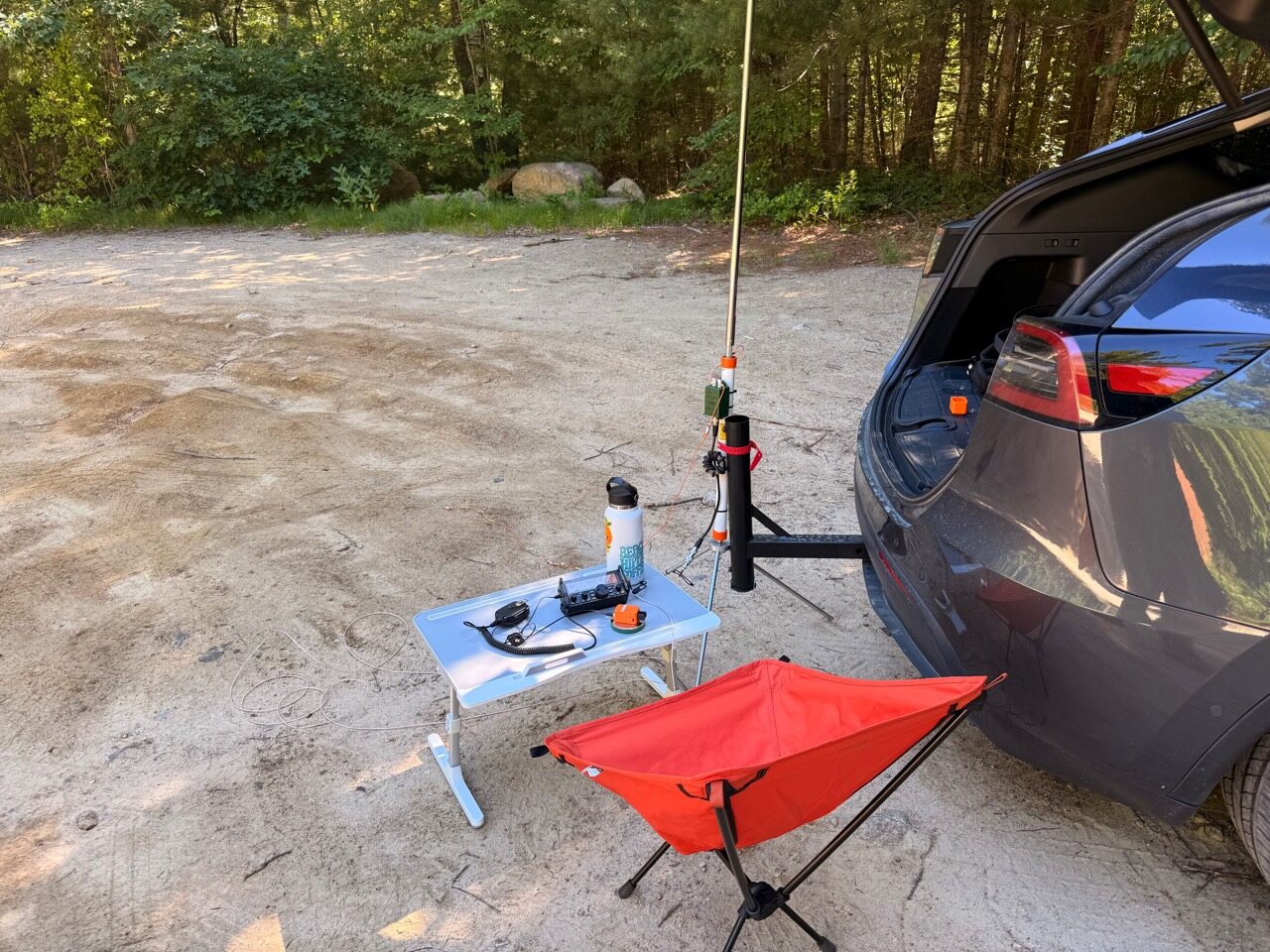
At a glance
- Where: Big River Wildlife Management Area, US-6982, Rhode Island
- When: June 16, 2026, 13:25 to 14:38 UTC
- Activation: 17 QSOs total; 13 CW and 4 SSB on 20 and 17 meters
- Radio: Elecraft KX2
- Antenna: KJ6ER Challenger off-center-fed dipole, on a freestanding tripod strapped to a hitch-mounted flagpole holder
- Power: 5 watts for most CW contacts; 10 watts for SSB and one later CW contact
- CW gear: KX2 with field logging in Ham2K Portable Logger
Field notes
The main thing I wanted to learn was whether the Challenger could stay quick to deploy while getting more support from the car. I set it up on the freestanding tripod, then used a Voile strap from my old bikepacking kit to tie the tripod and mast against the hitch-mounted flagpole holder. It was still fast, but the hitch mount gave the whole setup a much better wind brace than the tripod alone.
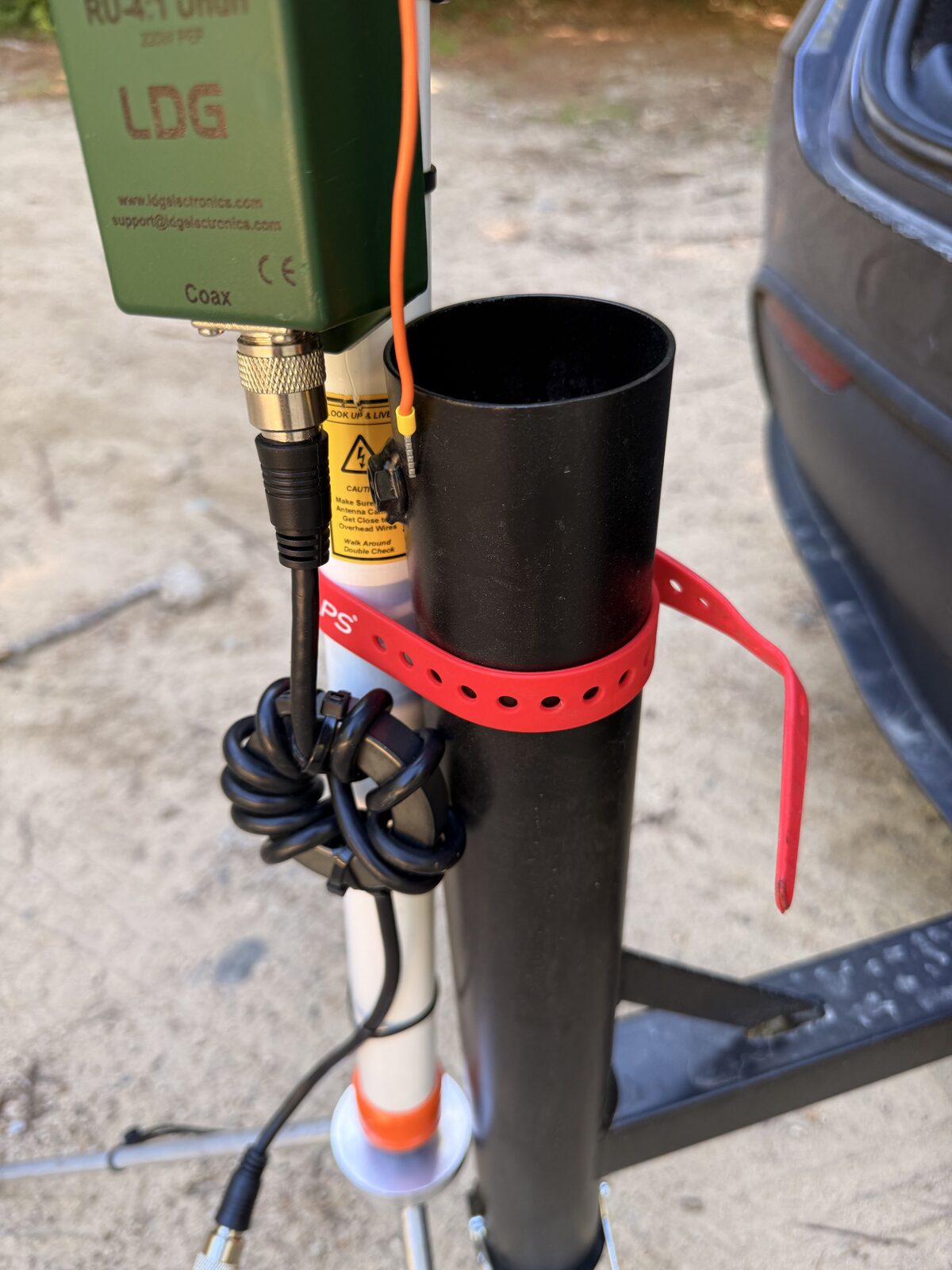
I think I will want something more permanent for the long term, but this worked well enough that I would use it again on the rove. I could have operated from inside the car, and I probably will for many of the car-based activations, but it was too nice outside to sit in the driver’s seat. The little table and chair beside the hatch made the operating position simple, and the antenna was still close enough to check without walking around the vehicle.
One thing this setup made me wonder about is whether a similar hitch brace could work with just the 25-foot stainless whip attached to the tripod base, more like a Rybakov-style vertical or a quarter-wave vertical than the full Challenger off-center-fed dipole. The open question would be how to keep the hitch from becoming part of the radiator, maybe with insulating foam between the whip and the hitch support, and then use ground radials instead of the linked counterpoise. I am not sure that is a good field experiment yet, but it is worth thinking through before the trip.
With the Challenger in its normal configuration I started on 20 meters. I hunted a few stations first, then found a spot and called CQ. The activation came together quickly: the first ten contacts were in the log in about 18 minutes, all on 20 meter CW at 5 watts.
After that I spent some time chasing a couple more stations and then switched into a second test: SSB on the KX2. I had not used the KX2 for sideband before, so this was a chance to sort out the hand mic, filtering, and voice memories in the field instead of learning them during the rove. Once I got the radio set up, I made four 20 meter SSB contacts at 10 watts. That was enough to prove the basic workflow and remind me where the settings live.
I also tried 17 meters with the Challenger. The short side of the off-center-fed dipole is linked with small Wago connectors for each band, so the change from 20 meters to 17 meters was just removing the small 20 meter link from that tail, then lowering the 25-foot mast. The mast change turned out to be exactly two sections down. Once I did that, 17 meters needed essentially no fussing, and I added one CW contact there before packing up.
The non-radio part of the morning was good too. A few dog walkers and hikers stopped by to ask what I was doing, and I had a longer 10- or 15-minute chat with a former ham whose license had lapsed. He was still excited about radio, especially Morse code, and he was picking out letters while I was operating. That kind of conversation is one of the parts of portable radio I keep enjoying: the gear is interesting, but the people who wander over are often just as much fun.
What worked
- Strapping the Challenger tripod to the hitch-mounted flagpole holder added useful wind support without making setup slow.
- The KX2, hand mic, and voice memory workflow made sense after a little field practice.
- The Challenger’s 17 meter change was easier than expected: remove the small 20 meter link from the short side and lower the mast two sections.
- Big River was busy enough for good passersby conversations without making the operating spot feel crowded.
To adjust next time
- Build or buy a more permanent hitch-support strap or bracket if this becomes the normal rove setup.
- Practice the KX2 SSB setup again before the trip so the filter, mic, and voice-memory steps are automatic.
- Come back to Big River for a proper hike-in activation when the goal is the park itself instead of the vehicle workflow.